Ten of Swords upright
Acknowledge the situation that has reached its limit. Attend to immediate support and practical closure instead of demanding an instant explanation or comeback.
What needs to happen now that this approach is finished?
10 · Swords · Minor Arcana
Ten of Swords represents a painful ending, the limit of an exhausted pattern, and the first acknowledgment of what is finished.
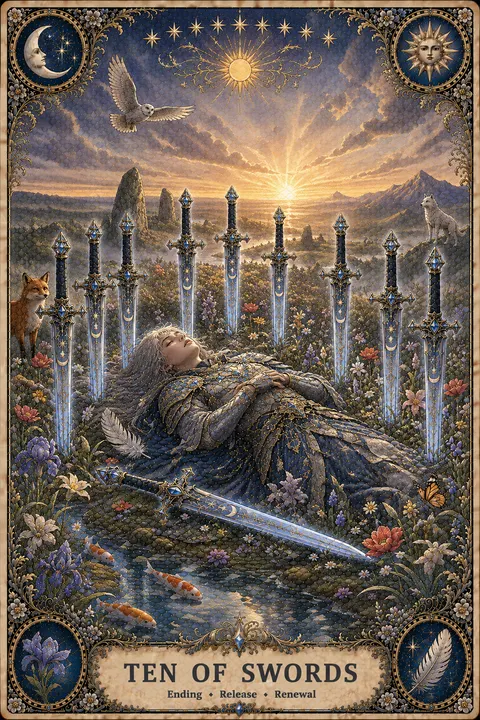
Ten brings the thought cycle to its limit. A painful conclusion can ask for closure rather than one more attempt to sustain the old story.
Acknowledge the situation that has reached its limit. Attend to immediate support and practical closure instead of demanding an instant explanation or comeback.
What needs to happen now that this approach is finished?
You may be beginning to recover perspective, or repeatedly reopening an ending. Let one completed detail remain complete.
A reversal shifts the question you ask of the card. Read more about upright and reversed meanings.
Upright: Acknowledge a final limit or a communication pattern that cannot continue.
Reversed: Do not reopen pain solely to seek a different version of the same ending.
Explore the wider relationship patternUpright: Close a failed approach and identify the immediate practical next task.
Reversed: Let review produce learning instead of an endless replay.
Reflect on how your situation is developingUpright: Assess the actual effect of an ended commitment.
Reversed: Separate practical repair from the wish to undo the past.
Separate your responsibility from what you cannot controlUpright: Bring the ending before God without turning defeat into your identity.
Reversed: A small next act of care can matter before hope feels convincing.
Put your reflection into wordsThese reference symbols come from the Waite–Smith tradition. Our artwork is a reimagining, so it may differ from the traditional scene described below. The practical readings are our interpretation of the imagery.
| Symbol | Meaning and reflection |
|---|---|
| Fallen figure | The image makes the limit of a struggle explicit. |
| Ten swords | Accumulation gives the scene a sense of finality. |
| Light on the horizon | The wider scene continues beyond the immediate ending. |
Historical imagery reference: A. E. Waite’s The Pictorial Key to the Tarot. This guide’s modern applications are offered for reflection.
Explore the wider symbolism in the themes of the tarot suits.
A position gives the card a role. Read the meaning below alongside the orientation and the surrounding cards, instead of treating the same keyword as the answer everywhere.
| Position | What to consider |
|---|---|
| Past | A painful ending changed the circumstances. |
| Present | An exhausted pattern has reached its limit. |
| Challenge | Replaying the ending is blocking closure. |
| Advice | Attend to the next manageable need. |
| Future or outcome | A completed ending may allow a new response. |
Question continuing an approach that has already reached a clear limit.
Read a need for closure rather than a date for harm or defeat.
Explore a focused yes-or-no questionIllustrative example · Not a generated reading
Suppose you ask, “What needs to happen now that this approach is finished?” and draw Ten of Swords upright. One way to apply its theme is to work through these steps:
Name what is over and care for the next manageable need. Record the action and what you learned in a tarot journal.
Ten of Swords represents a painful ending, the limit of an exhausted pattern, and the first acknowledgment of what is finished. Acknowledge the situation that has reached its limit. Attend to immediate support and practical closure instead of demanding an instant explanation or comeback.
You may be beginning to recover perspective, or repeatedly reopening an ending. Let one completed detail remain complete.
Acknowledge a final limit or a communication pattern that cannot continue. Reversed: Do not reopen pain solely to seek a different version of the same ending.
Question continuing an approach that has already reached a clear limit. Treat this as a way to examine your choice, rather than a guaranteed result.
Ten brings the thought cycle to its limit. A painful conclusion can ask for closure rather than one more attempt to sustain the old story.
Read a need for closure rather than a date for harm or defeat.
Name what is over and care for the next manageable need. A practical starting point: Name the completed ending.
No. This guide reads the dramatic image as symbolic ending and exhaustion. It is not evidence that harm will occur.
Choose your cards and orientations in the Tarot Cards Interpreter for help connecting a supported spread to your question. Your physical cards stay your draw; the tool adds an AI interpretation.
If you want to start a new reading, draw a random card online. A new draw can select any card.
For the reading process, return to how to read tarot cards.
God, help me stop fighting what is finished and care for the life that continues.