Death upright
Recognize an ending instead of spending all your energy preserving it. Make room for grief, practical closure, and the gradual shape of what comes after.
How can I let go of a project that no longer fits?
XIII · Major Arcana
Death represents an ending, release, and the transition that follows when an old form of life is finished.
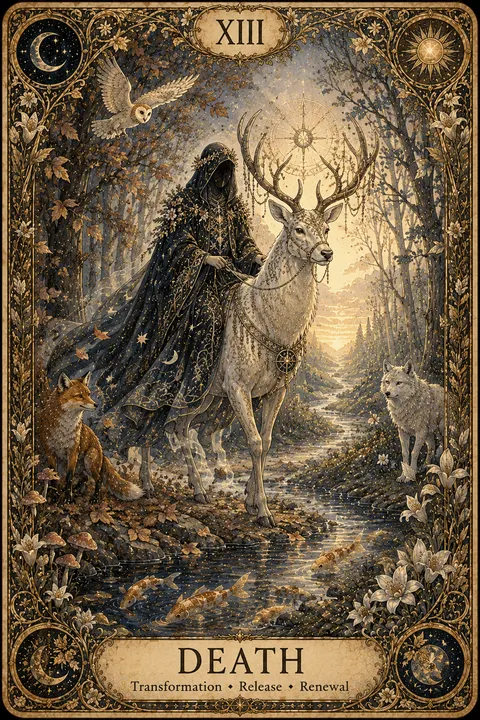
XIII follows the suspended viewpoint of XII with a clearer threshold. Renewal requires acknowledging what can no longer continue in its present form.
Recognize an ending instead of spending all your energy preserving it. Make room for grief, practical closure, and the gradual shape of what comes after.
How can I let go of a project that no longer fits?
Clinging or fear may prolong an exhausted pattern. Release can happen gradually; begin by naming the part that has already changed.
A reversal shifts the question you ask of the card. Read more about upright and reversed meanings.
Upright: Acknowledge a changed relationship pattern and discuss what must end or evolve.
Reversed: Avoid preserving an old dynamic solely because it is familiar.
Explore the wider relationship patternUpright: Close an outdated responsibility so attention can move elsewhere.
Reversed: Examine whether loyalty to an old role is preventing necessary change.
Reflect on how your situation is developingUpright: Review commitments attached to a chapter that has ended.
Reversed: Notice ongoing costs maintained only through reluctance to let go.
Separate your responsibility from what you cannot controlUpright: Bring grief and release before God without demanding immediate renewal.
Reversed: Allow an old self-description to soften when it no longer fits your life.
Put your reflection into wordsThese reference symbols come from the Waite–Smith tradition. Our artwork is a reimagining, so it may differ from the traditional scene described below. The practical readings are our interpretation of the imagery.
| Symbol | Meaning and reflection |
|---|---|
| Armored skeleton | The figure makes change visible across differences in status. |
| White rose on a dark banner | The contrast gives endings a language of transformation and renewal. |
| Distant sunrise | A continuing horizon sits beyond the immediate scene of release. |
Historical imagery reference: A. E. Waite’s The Pictorial Key to the Tarot. This guide’s modern applications are offered for reflection.
Explore the wider symbolism in the themes of the tarot suits.
A position gives the card a role. Read the meaning below alongside the orientation and the surrounding cards, instead of treating the same keyword as the answer everywhere.
| Position | What to consider |
|---|---|
| Past | An ending transformed the circumstances. |
| Present | Closure needs to be acknowledged. |
| Challenge | Clinging is extending an exhausted pattern. |
| Advice | Release what is genuinely finished. |
| Future or outcome | A changed chapter may make room for renewal. |
It questions continuing unchanged; ask whether your proposal allows a needed ending.
Transition follows real closure, not a date encoded in thirteen.
Explore a focused yes-or-no questionIllustrative example · Not a generated reading
Suppose you ask, “How can I let go of a project that no longer fits?” and draw Death upright. One way to apply its theme is to work through these steps:
Complete one honest act of closure and leave room for transition. Record the action and what you learned in a tarot journal.
Death represents an ending, release, and the transition that follows when an old form of life is finished. Recognize an ending instead of spending all your energy preserving it. Make room for grief, practical closure, and the gradual shape of what comes after.
Clinging or fear may prolong an exhausted pattern. Release can happen gradually; begin by naming the part that has already changed.
Acknowledge a changed relationship pattern and discuss what must end or evolve. Reversed: Avoid preserving an old dynamic solely because it is familiar.
It questions continuing unchanged; ask whether your proposal allows a needed ending. Treat this as a way to examine your choice, rather than a guaranteed result.
XIII follows the suspended viewpoint of XII with a clearer threshold. Renewal requires acknowledging what can no longer continue in its present form.
Transition follows real closure, not a date encoded in thirteen.
Complete one honest act of closure and leave room for transition. A practical starting point: Name what the project once gave you.
No. This guide reads it as symbolic ending and transition. It cannot establish a person's health, lifespan, or fate.
Choose your cards and orientations in the Tarot Cards Interpreter for help connecting a supported spread to your question. Your physical cards stay your draw; the tool adds an AI interpretation.
If you want to start a new reading, draw a random card online. A new draw can select any card.
For the reading process, return to how to read tarot cards.
God, stay with me in the space between what has ended and what is not yet clear.