Five of Swords upright
Examine the cost of proving a point. An argument may produce a winner while damaging the trust needed for any useful result.
Is continuing this argument helping anything important?
5 · Swords · Minor Arcana
Five of Swords represents conflict, the cost of winning, and deciding which arguments deserve your participation.
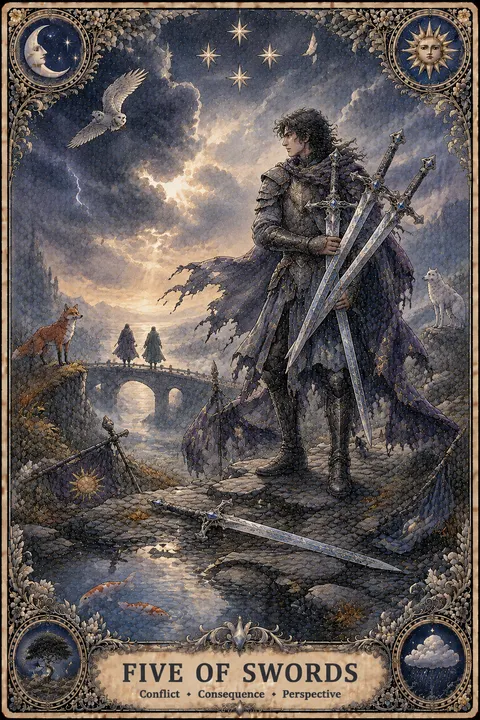
Five disrupts the balance of thought and communication. Ask what remains of the relationship or task after a victory.
Examine the cost of proving a point. An argument may produce a winner while damaging the trust needed for any useful result.
Is continuing this argument helping anything important?
Repair or disengagement may be possible, but unresolved resentment can keep the conflict alive. Name the issue without reopening every grievance.
A reversal shifts the question you ask of the card. Read more about upright and reversed meanings.
Upright: Stop treating a disagreement as a contest for the superior position.
Reversed: Acknowledge your contribution before asking for reconciliation.
Explore the wider relationship patternUpright: Clarify the task when competition has displaced collaboration.
Reversed: Record a fair agreement rather than continuing a status argument.
Reflect on how your situation is developingUpright: Consider the wider cost of a dispute over resources.
Reversed: Seek a clear practical agreement instead of escalating to save face.
Separate your responsibility from what you cannot controlUpright: Ask whether pride is using truth as a weapon.
Reversed: Humility can include apologizing or leaving a destructive contest.
Put your reflection into wordsThese reference symbols come from the Waite–Smith tradition. Our artwork is a reimagining, so it may differ from the traditional scene described below. The practical readings are our interpretation of the imagery.
| Symbol | Meaning and reflection |
|---|---|
| Collected swords | A visible victory can leave a larger loss uncounted. |
| Retreating figures | The aftermath reveals the relational cost of conflict. |
| Rough sky | The atmosphere remains unsettled after the apparent result. |
Historical imagery reference: A. E. Waite’s The Pictorial Key to the Tarot. This guide’s modern applications are offered for reflection.
Explore the wider symbolism in the themes of the tarot suits.
A position gives the card a role. Read the meaning below alongside the orientation and the surrounding cards, instead of treating the same keyword as the answer everywhere.
| Position | What to consider |
|---|---|
| Past | A costly conflict shaped present distrust. |
| Present | The price of winning needs examination. |
| Challenge | Pride is extending the argument. |
| Advice | Choose a useful boundary or sincere repair. |
| Future or outcome | A changed response may interrupt the contest. |
Question a choice whose main attraction is defeating or humiliating someone.
Resolution depends on changed participation, not another round of argument.
Explore a focused yes-or-no questionIllustrative example · Not a generated reading
Suppose you ask, “Is continuing this argument helping anything important?” and draw Five of Swords upright. One way to apply its theme is to work through these steps:
Choose a boundary or repair that serves more than winning. Record the action and what you learned in a tarot journal.
Five of Swords represents conflict, the cost of winning, and deciding which arguments deserve your participation. Examine the cost of proving a point. An argument may produce a winner while damaging the trust needed for any useful result.
Repair or disengagement may be possible, but unresolved resentment can keep the conflict alive. Name the issue without reopening every grievance.
Stop treating a disagreement as a contest for the superior position. Reversed: Acknowledge your contribution before asking for reconciliation.
Question a choice whose main attraction is defeating or humiliating someone. Treat this as a way to examine your choice, rather than a guaranteed result.
Five disrupts the balance of thought and communication. Ask what remains of the relationship or task after a victory.
Resolution depends on changed participation, not another round of argument.
Choose a boundary or repair that serves more than winning. A practical starting point: Name the result you actually need.
No. It invites an honest look at how conflict is unfolding and what participation you can change, without reducing anyone to a fixed role.
Choose your cards and orientations in the Tarot Cards Interpreter for help connecting a supported spread to your question. Your physical cards stay your draw; the tool adds an AI interpretation.
If you want to start a new reading, draw a random card online. A new draw can select any card.
For the reading process, return to how to read tarot cards.
God, help me recognize when pride is prolonging conflict and choose a more truthful peace.