Updated
I Don't Believe in God, But I Know There Is God
A spiritual reflection on the difference between believing and knowing God, why knowing requires less force than belief, and how tarot can be one channel for divine messages.
Guide
8 min read
A sentence that sounds like a contradiction
I do not believe in God, but I know there is God. At first, that sentence sounds confused. Many people use belief and knowing as if they are the same thing. But spiritually, they can describe two different stages of relationship with truth.
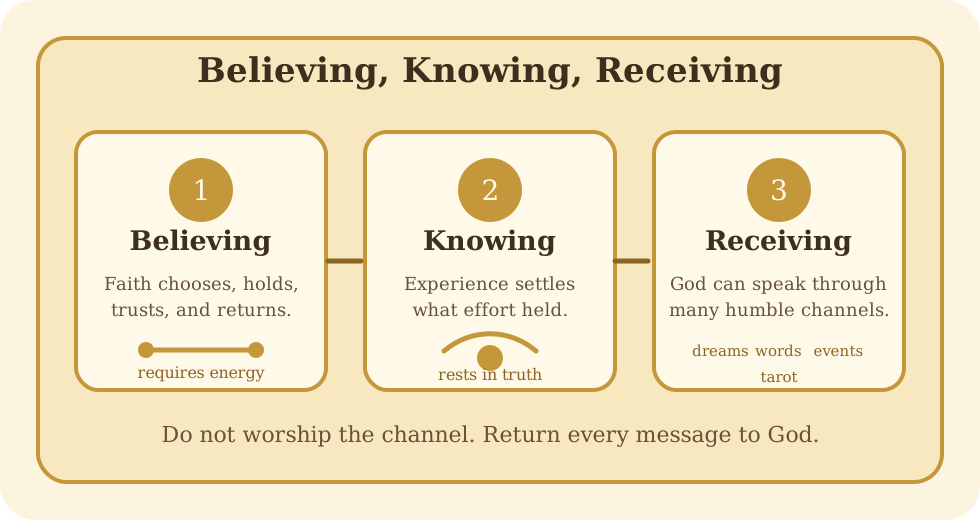
Belief is often the bridge. Knowing is what happens after something in life has crossed that bridge and become settled inside you. Belief says, I trust this is true. Knowing says, I cannot unknow what has been shown to me.
Belief requires energy
Believing in something can require energy. You may have to choose it, defend it, repeat it, protect it from doubt, and return to it when fear or confusion rises. That does not make belief weak. Faith can be holy. But belief still asks something of the person carrying it.
When belief has not yet become knowing, the soul may feel the strain of holding it. It may need reassurance. It may seek proof. It may feel threatened when someone questions it. That is why belief can become exhausting when the heart is trying to force certainty before certainty has ripened.
Knowing does not need the same force
Knowing does not require the same energy because it is no longer being held up by effort. You do not wake up each morning forcing yourself to believe you exist. You know. You do not argue yourself into believing fire is hot after it has burned you. You know.
Spiritual knowing can feel like that. Because of a certain event in life, a person may know there is God. They may not be able to prove it in a way that satisfies everyone else. They may not expect another person to have the same experience. Still, within them, the matter is no longer theoretical.
Personal experience cannot be demanded from others
This is where humility matters. If an event in your life made God's reality undeniable to you, that does not mean other people are dishonest because they have not seen what you saw. They may be at a different stage. They may need a different kind of encounter. They may carry wounds, questions, or histories you do not know.
Knowing should not make a person arrogant. It should make them quieter, clearer, and more compassionate. A real encounter with God does not need to be used as a weapon. It can be held as testimony, not as pressure.
God is not reduced by tarot
For some people, tarot feels like a threat to faith because their faith is still being defended as a belief system. They fear that if another symbolic language enters the room, the belief will weaken. But when there is no belief left to defend because the knowing is already settled, tarot does not reduce God.
Tarot is not the source. Tarot is not worship. Tarot is not higher than prayer, conscience, scripture, wisdom, or direct relationship with God. It is simply a means, a channel, a symbolic surface through which a message may be reflected from the divine world.
The Divine can speak through many channels
People receive divine messages through dreams. They receive them through a sentence someone says without knowing why it matters. They receive them through timing, closed doors, repeated numbers, sudden memory, events that arrange themselves with strange precision, and quiet conviction that arrives without drama.
Tarot belongs in that larger family of symbolic channels. The card is not powerful because cardboard controls destiny. The card becomes meaningful when divine wisdom uses image, number, archetype, and timing to reveal what the soul needs to see.
Knowing still needs discernment
There is an important distinction: knowing there is God does not mean every interpretation is automatically correct. God may be real, but your reading of a sign can still be mixed with fear. A dream can be meaningful, but your conclusion can still be rushed. A tarot card can be timely, but your desire can still distort the message.
That is why knowing must stay humble. The knowing of God can be firm while the interpretation remains open to testing. Ask whether the message produces truth, love, responsibility, patience, courage, and peace. Ask whether it returns you to God or pulls you into obsession.
A later stage is quieter
Knowing is often a later stage than believing because it becomes quieter. It does not need to perform certainty. It does not need to win every argument. It does not collapse when another person doubts. It can simply stand there, rooted in what has been lived.
A person who knows there is God can still learn, still repent, still test messages, still respect other people's journeys, and still use tarot as a reflective channel. The knowing is not fragile. It is settled enough to let truth move through dreams, words, events, silence, and cards without confusing the channel for the Source.
A reflective closing
Belief says, I am choosing to trust. Knowing says, I have encountered something I cannot honestly deny. Both can have a place. But when knowing arrives, it rests differently. It does not need the same energy because the soul is no longer trying to hold God up. God is already there.
Prayer-like affirmation: God of truth and divine order, keep my knowing humble. Let every dream, word, event, number, silence, and tarot card return me to You. Help me receive messages without worshiping the channel, and help me honor other people whose path to knowing is not the same as mine.
Believing and Knowing in Spiritual Life
A practical comparison for understanding belief, knowing, and tarot as a reflective channel rather than a competing authority.
| Spiritual posture | What it feels like | How tarot fits |
|---|---|---|
| Believing | You hold an idea by faith, trust, teaching, hope, or chosen conviction. | Tarot may support reflection, but fear can make you ask for reassurance again and again. |
| Knowing | You are not forcing the idea anymore because an event, encounter, or inner certainty has settled it. | Tarot does not reduce the knowing. It becomes one symbolic channel among many. |
| Testing | You remain humble because your interpretation can still be wrong even when God is real. | A card should be weighed through prayer, conscience, timing, truth, and wise counsel. |
| Receiving | You notice that divine wisdom can arrive through dreams, words, events, patterns, silence, and signs. | Tarot can mirror a message, but it should never replace God as the source. |
| Living | You stop trying to prove everything and start responding with responsibility, love, courage, and discernment. | A reading becomes useful when it returns you to God, clarity, and grounded action. |

Written by
Lucia Aurelia
Tarot educator and symbolic reflection writer
Lucia Aurelia writes about tarot as a reflective language for symbols, questions, journaling, and grounded spiritual practice.
Common Questions
I Don't Believe in God, But I Know There Is God FAQ
What does it mean to know there is God instead of believe in God?
It means the person is not only holding a doctrine or hope. Something in life has made God's reality personally settled for them, even if they cannot transfer that experience to another person.
Is knowing God better than believing in God?
Knowing can be a later stage because it requires less inner force, but it should still remain humble. A person may know God is real while still needing correction about what a message, sign, or experience means.
Does using tarot weaken faith in God?
Not when tarot is kept in its proper place. Tarot is not God, not worship, and not final authority. It can be one symbolic channel for reflection, similar to how people notice dreams, words, events, timing, and repeated patterns.
More From The Blog
Continue reading tarot education.

8 min read
Hidden in Plain Sight: Tarot, Secrets, and Spiritual Discernment
Important truths are sometimes hidden by distraction, jokes, confusion, and devaluation. Learn how tarot can train discernment without becoming paranoid.
Read article
9 min read
Is God Real? Why an Imperfect World Does Not Disprove God
A spiritual reflection on why war, sickness, crime, and suffering do not automatically disprove God, and how polarity makes human experience possible.
Read articlePractice with one card
Ask a question, draw a card, and use the reading as the first entry in your tarot journal.