Updated
How to Handle a World That Criticizes Before It Understands
A God-first reflection on criticism, judgment, incomplete information, humility, and staying steady when people speak about paths they have never walked.

Guide
8 min read
Most judgment is spoken from partial sight
One of the hardest things about living in the world is that people often judge faster than they understand. They see one moment, one decision, one sentence, one failure, one relationship, one reaction, or one season of your life, and they speak as if they have seen the whole book.
But human beings rarely know the full information. They do not know every prayer, every private wound, every sacrifice, every hidden pressure, every impossible option, every conversation that happened behind closed doors, or every lesson God has been walking you through.
People speak from the path they have walked
A person who has never carried your responsibility may judge your tiredness as weakness. A person who has never loved someone difficult may judge your patience as foolishness. A person who has never had to start over may judge your hesitation as laziness. A person who has never been trapped may judge your fear as drama.
This does not always make them cruel. Sometimes they are simply limited by the road they have walked. Their advice may come from sincerity, but sincerity does not automatically create understanding.
Do not make every critic your court
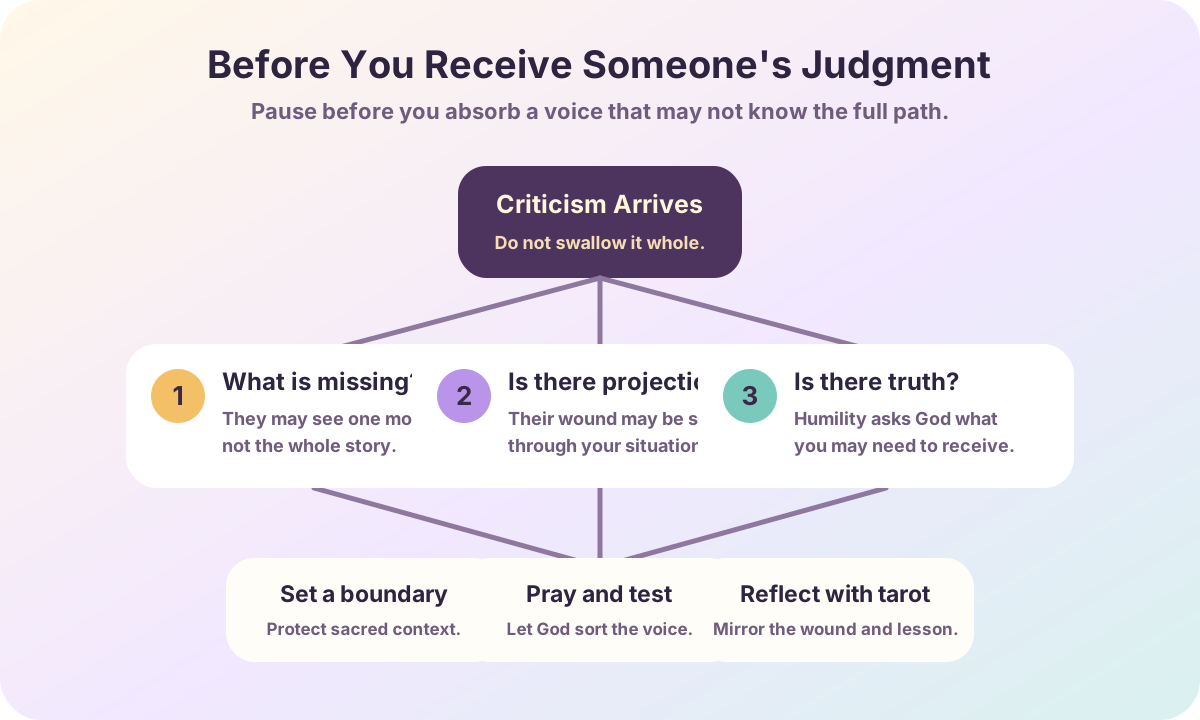
If you treat every opinion as a courtroom, you will spend your whole life defending your soul to people who were never assigned to judge it. You will explain, over-explain, perform innocence, collect evidence, and exhaust yourself trying to be understood by people who may not even want truth.
There is a difference between accountability and public trial. Accountability happens with God, conscience, wise counsel, and people directly affected by your choices. Public trial happens when random voices demand access to context they have not earned.
Still, do not use misunderstanding as an excuse to reject correction
There is another danger: when we have been judged unfairly, we may start rejecting every correction as ignorance. That is not wisdom. Sometimes a person has incomplete information and still sees one true thing. Sometimes God uses an uncomfortable voice to reveal pride, avoidance, carelessness, or a pattern we did not want to face.
Maturity is not saying, nobody understands me, so nobody can correct me. Maturity is saying, this person may not know the full story, but I will ask God whether there is any truth here that I need to receive.
Protect private context without becoming hard
Not everyone deserves the full story. Some information is sacred. Some pain belongs only in prayer, therapy, wise counsel, or a private conversation with the people who are actually involved. You do not have to expose your whole inner life to earn the right to be treated with basic humanity.
At the same time, protecting yourself should not become bitterness. The goal is not to hate critics. The goal is to stop letting incomplete voices become the ruler of your heart.
Ask what the criticism is producing in you
A useful question is not only, are they right? A deeper question is, what is this producing in me? Is it producing humility, responsibility, repentance, courage, and clearer love? Or is it producing panic, shame, rage, obsession, self-hatred, and the need to prove myself?
Truth can hurt, but truth does not need to destroy your soul. God may convict, but divine correction does not require humiliation as entertainment. If a criticism pulls you toward honesty and repair, listen. If it pulls you into spiritual confusion and self-erasure, pause before receiving it as truth.
Tarot can help separate the wound from the lesson
Tarot can be useful here when it stays in its proper place. A reading is not for proving that your critics are evil or that you are always right. A better spread might ask: What part of this criticism is touching an old wound? What part may contain truth? What boundary is needed? What response would honor God?
Justice may ask whether you are being fair. The Hermit may ask you to stop performing for the crowd and return to quiet truth. Strength may show restraint. The Moon may reveal projection, fear, or confusion. Temperance may ask you to respond with measured wisdom instead of emotional revenge.
God knows the context people do not
There is comfort in remembering that God sees the whole path. God sees what happened before the moment others judged. God sees what you were carrying, what you were afraid of, what you tried to do right, where you failed, where you need mercy, and where you need correction.
This does not mean you are automatically innocent. It means you are fully seen. Human judgment is often partial, but divine sight is complete. Let that make you humble, not careless. Let it make you steady, not proud.
A reflective closing
When people criticize without knowing the full information, you do not need to collapse under every voice. Listen for truth. Reject projection. Protect what is sacred. Stay correctable. Stay soft enough for God to teach you and strong enough not to be ruled by people who never walked your path.
Prayer-like affirmation: God of truth and divine order, keep me humble when criticism carries wisdom and steady when judgment is incomplete. Help me receive correction without shame, set boundaries without hatred, and remember that Your sight is fuller than any human opinion.
Criticism, Judgment, and Discernment
Not every criticism should be rejected, and not every criticism should be absorbed. Discernment asks what is true, what is partial, and what belongs to God.
| What happens | Immature response | God-centered response |
|---|---|---|
| Someone criticizes your choice | I must defend myself until they finally understand. | I can listen for truth without making their opinion my judge. |
| They do not know the full story | I will explain every private detail so they stop judging me. | I can protect sacred context and let God know what people do not know. |
| They never walked that path | They have no right to speak at all. | Their view may be limited, but I can still test whether any part contains wisdom. |
| Their words trigger shame | Their criticism proves something is wrong with me. | A triggered wound needs care, not instant agreement with the critic. |
| Your own pride reacts | Nobody can correct me because they do not understand. | Humility lets me receive correction without surrendering my whole identity. |
| Tarot reflection | The cards must prove that I am right and they are wrong. | The cards can mirror my wound, pride, boundary, lesson, and next faithful response. |

Written by
Lucia Aurelia
Tarot educator and symbolic reflection writer
Lucia Aurelia writes about tarot as a reflective language for symbols, questions, journaling, and grounded spiritual practice.
Common Questions
How to Handle a World That Criticizes Before It Understands FAQ
How do I handle people who judge me without knowing the full story?
Listen for any useful truth, but do not hand your peace to people who lack the full context. Some parts of your life are between you, God, wise counsel, and the people directly involved.
Should I explain myself when people criticize me unfairly?
Sometimes explanation is loving and necessary. Other times it becomes self-abandonment. Discern whether the person is seeking truth, seeking control, or simply speaking from an incomplete picture.
Can tarot help when I feel judged or misunderstood?
Tarot can help you reflect on what the criticism triggered, what boundary is needed, what pride may be involved, and what God may be teaching you. It should not replace prayer, conscience, wise counsel, or direct action where action is needed.
More From The Blog
Continue reading tarot education.

8 min read
Hidden in Plain Sight: Tarot, Secrets, and Spiritual Discernment
Important truths are sometimes hidden by distraction, jokes, confusion, and devaluation. Learn how tarot can train discernment without becoming paranoid.
Read article
9 min read
Is God Real? Why an Imperfect World Does Not Disprove God
A spiritual reflection on why war, sickness, crime, and suffering do not automatically disprove God, and how polarity makes human experience possible.
Read articlePractice with one card
Ask a question, draw a card, and use the reading as the first entry in your tarot journal.