Updated
Making Life's Hardest Decisions When There Is No Easy Right or Wrong
A God-first reflection on medical, love, career, family, and spiritual decisions where there is no easy right or wrong, and why love is wiser than fear.
Guide
8 min read
Some decisions do not offer an easy clean answer
The hardest decisions in life are rarely between obvious good and obvious evil. If the answer were simple, you would not be losing sleep over it. The truly difficult choices often sit between two goods, two losses, two duties, or two versions of love that cannot both be held in the same way.
You may have to choose between treatment options, staying and leaving, speaking and waiting, protecting yourself and protecting someone else, taking the stable career path and beginning again, honoring what came before and admitting that a season is over. There may be no path where nobody hurts, nobody misunderstands, and nothing is sacrificed.
Examples of life's hardest decisions
Some hard decisions are medical: whether to continue a difficult treatment, seek another opinion, become a caregiver, change a care plan, or accept that the body has limits. These choices should involve qualified medical guidance, prayer, honest conversation, and compassion for everyone carrying the weight.
Some are love decisions: whether to stay or leave, forgive or create distance, confess the truth, wait for someone, end a relationship, repair a marriage, or stop repeating a pattern that keeps injuring the soul.
Some are career decisions: whether to leave a stable job, start again, choose purpose over comfort, move for work, close a business, protect your integrity at a cost, or accept that a season of ambition has ended.
Some are family or spiritual decisions: whether to set a boundary with a parent, care for someone who once hurt you, change your faith community, say no to a role everyone expects you to carry, or choose a quieter life that other people do not understand.
Everyone around you will have an opinion
When you ask people around you, they will often answer from their own story. One person tells you to be practical because they were once punished for being too hopeful. Another tells you to take the risk because they regret staying too long. Another tells you to forgive because they fear conflict. Another tells you to leave because they fear being trapped.
Their opinions may be sincere. Some may even be wise. But they are still filtered through their wounds, values, fears, loyalties, and experiences. Advice can help you see the room more clearly, but it cannot live your life for you.
There may be no absolute right decision
In this imperfect world, many decisions are relative, not absolute. Only God is absolute. Mathematical truth can be fixed inside its system, but human life moves through context, timing, limitation, emotion, body, history, and consequence.
This means a decision can be responsible and still painful. A choice can be loving and still misunderstood. A path can be necessary and still involve grief. The fact that a decision is not perfectly clean does not mean it is wrong. It may simply mean you are human, choosing inside an imperfect world.
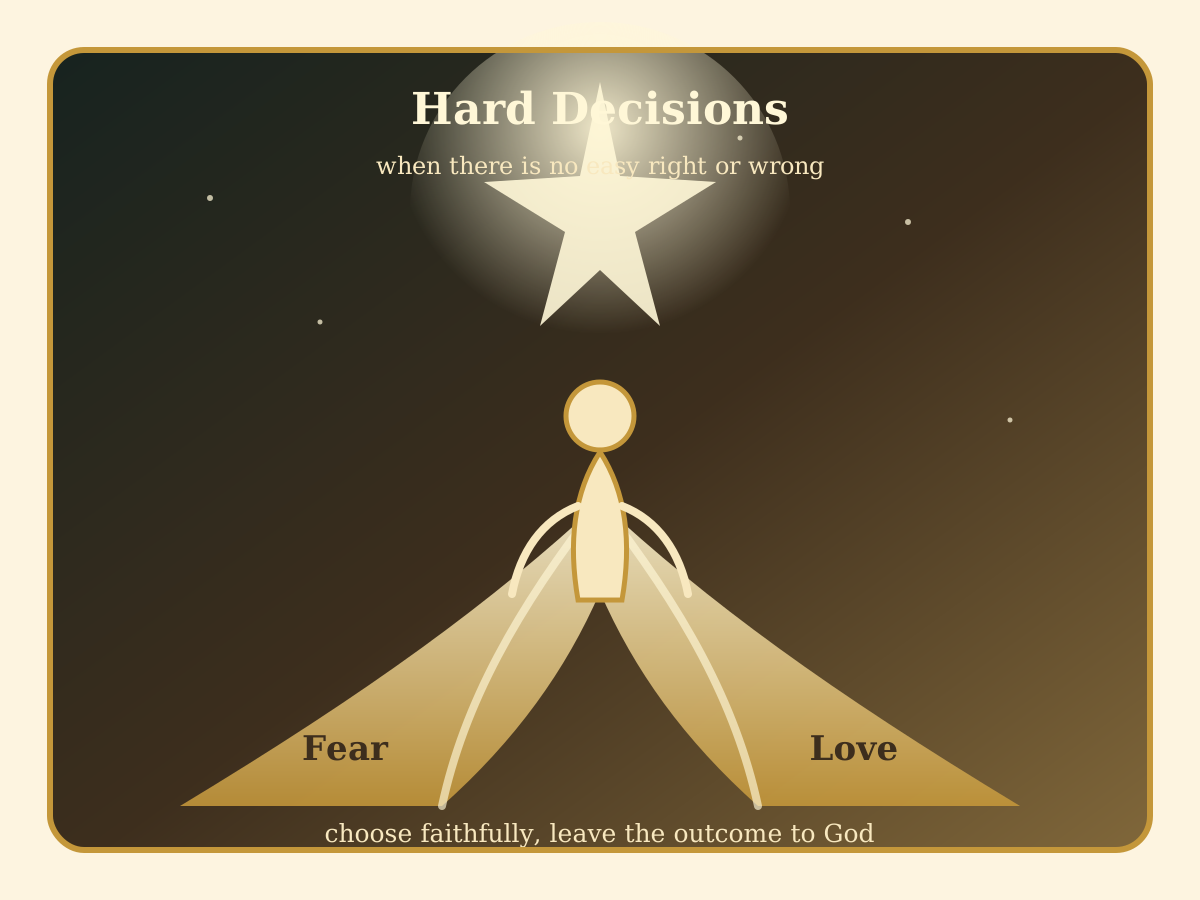
Fear asks for control
Fear wants a decision that guarantees safety, approval, certainty, and no regret. Fear says: choose the path where nobody can blame you. Choose the path where you cannot lose. Choose the path where you never have to feel the unknown.
But fear is not the same as wisdom. Fear can notice danger, but it should not sit on the throne. When fear leads, the soul often chooses avoidance and calls it peace, control and calls it responsibility, or delay and calls it discernment.
Love tells the truth more quietly
Love is not always soft. Sometimes love says stay and repair. Sometimes love says leave and stop enabling harm. Sometimes love says speak. Sometimes love says wait. Sometimes love says forgive without returning to the same pattern.
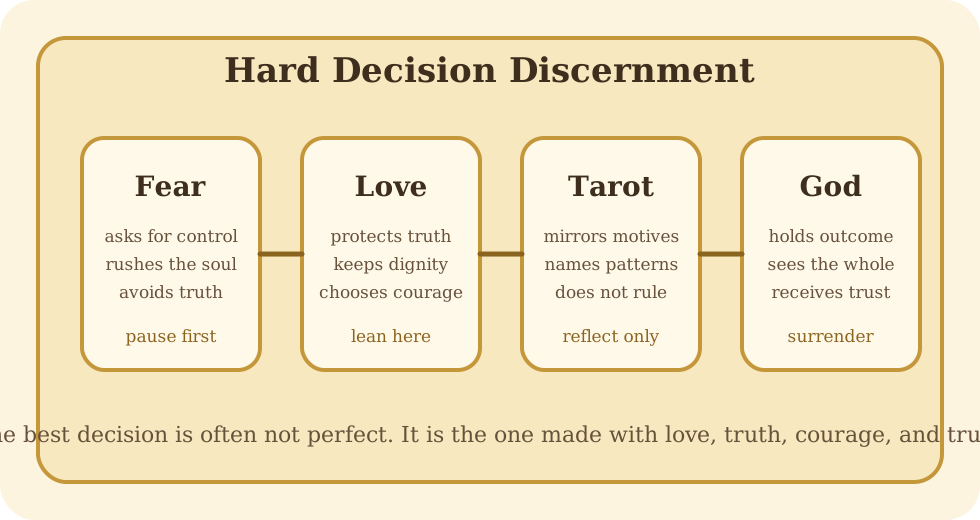
The best decisions are usually guided more by love than fear. Love asks: What protects truth? What preserves dignity? What honors God? What keeps my heart from becoming cruel, passive, dishonest, or proud? What choice can I make without betraying the deepest thing I know is true?
The decision may already be held by God
There is a mysterious way to understand decision-making: the decision that needs to be made has already been made in the sight of God, and you are here to experience walking into it. God is not trapped in your anxiety about time. The whole path is already visible to divine wisdom.
This does not mean you become passive. It means your choosing is part of the experience. You are not here only to produce an outcome. You are here to meet the lesson, feel the tension, learn what love costs, discover what fear tries to protect, and surrender the final meaning back to God.
Regret is not always proof of a wrong choice
People often think regret means they chose wrong. But sometimes regret is simply grief speaking after a necessary choice. You can miss the road you did not take. You can wonder about the life you did not live. You can feel sadness without needing to condemn your decision.
A hard decision usually closes one door so another experience can unfold. The closed door may still matter. It may still have love in it. But love does not always mean keeping every door open forever.
Tarot can help you hear the question beneath the question
Tarot can help when it is kept in its proper place. The cards should not be used as a machine that removes responsibility. They are more useful as symbolic mirrors. A spread can ask: What fear is shaping me? What love is asking of me? What truth am I avoiding? What lesson belongs to this decision?
The Lovers may reveal value alignment. Justice may ask for honesty and consequence. The Hanged Man may show surrender. The Moon may reveal fear disguised as intuition. The Hermit may ask you to stop outsourcing the answer to every voice around you.
Do not ask tarot to replace God
Tarot can clarify a pattern, but God remains the highest authority. A card cannot carry the final burden of your life. A reading cannot promise a painless outcome. A spread cannot remove the sacred weight of choosing.
Use tarot to reflect. Use prayer to surrender. Use counsel to widen your sight. Use conscience to test the fruit. Use action to walk forward. Do not confuse the mirror with the Source.
A decision made in love is still an act of faith
Even after prayer, advice, reflection, and tarot, you may still not feel perfectly certain. That is normal. Some decisions are not resolved by certainty. They are resolved by faithfulness.
You choose the path that is more honest, more loving, more courageous, more aligned with divine order, and less ruled by panic. Then you let God hold what you cannot control: the outcome, the reaction of others, the timing, the hidden consequences, and the meaning that will only become visible later.
A reflective closing
If you are facing one of life's hardest decisions, ask yourself: Am I trying to choose from fear or from love? Am I asking everyone for certainty because I do not want to carry the weight of my own soul? What choice protects truth without making fear my god?
Prayer-like affirmation: God of wisdom and divine order, guide me through the decision that has no easy answer. Let love be stronger than fear. Let truth be stronger than approval. Let tarot, counsel, and reflection serve only as mirrors, while You remain the final authority over my path.
Love-Based and Fear-Based Decision Signals
When there is no easy right or wrong, the deeper question is often what spirit is guiding the decision.
| Signal | Fear-led version | Love-led version |
|---|---|---|
| Timing | I must decide now or everything will collapse. | I can act with urgency if needed, but not with panic as my master. |
| Advice from others | Everyone must agree before I feel safe. | I can listen carefully and still accept that the choice is mine before God. |
| Medical decisions | I only want the option that removes fear, uncertainty, or future grief. | I seek qualified medical guidance, pray for wisdom, and choose the path that best protects life, dignity, and peace. |
| Love decisions | I stay, leave, confess, or forgive only because I fear loneliness, blame, or losing control. | I ask what choice protects truth, dignity, compassion, and the kind of love God can bless. |
| Career decisions | I choose only for status, fear of failure, money panic, or other people's approval. | I consider provision, calling, stewardship, family impact, integrity, and the work that lets me serve faithfully. |
| Responsibility | I am choosing only to avoid blame, loss, or discomfort. | I am choosing what protects truth, dignity, compassion, and the next faithful step. |
| Tarot reflection | The cards must tell me the one perfect answer. | The cards can mirror my motives, fears, and patterns while God remains higher. |
| Outcome | If the outcome hurts, I chose wrong. | A hard outcome does not prove the choice was loveless, foolish, or outside God's sight. |
Written by
Lucia Aurelia
Tarot educator and symbolic reflection writer
Lucia Aurelia writes about tarot as a reflective language for symbols, questions, journaling, and grounded spiritual practice.
Common Questions
Making Life's Hardest Decisions When There Is No Easy Right or Wrong FAQ
How do I make a hard decision when there is no clear right or wrong?
Start by separating fear from love. Ask what protects truth, dignity, responsibility, and compassion. Listen to wise counsel, but accept that no outside opinion can remove the weight of your own discernment before God.
Can tarot tell me the right decision?
Tarot can help reflect on motives, fears, patterns, and possible lessons, but it should not be treated as final authority. God, conscience, wisdom, and responsible action remain higher than the cards.
What does it mean that the decision has already been made?
From a God-first view, time is held within divine knowledge. That does not make you passive. It means the choice you are walking into is also part of the experience your soul is here to meet, learn from, and surrender back to God.
More From The Blog
Continue reading tarot education.

8 min read
Hidden in Plain Sight: Tarot, Secrets, and Spiritual Discernment
Important truths are sometimes hidden by distraction, jokes, confusion, and devaluation. Learn how tarot can train discernment without becoming paranoid.
Read article
9 min read
Is God Real? Why an Imperfect World Does Not Disprove God
A spiritual reflection on why war, sickness, crime, and suffering do not automatically disprove God, and how polarity makes human experience possible.
Read articlePractice with one card
Ask a question, draw a card, and use the reading as the first entry in your tarot journal.