Three of Swords upright
Name the hurt and what actually happened. Clear language can help you seek support or communicate a need without minimizing the pain.
How can I talk about this hurt without turning the conversation into blame?
3 · Swords · Minor Arcana
Three of Swords represents painful truth, heartbreak, and making room for sorrow without turning it into your whole identity.
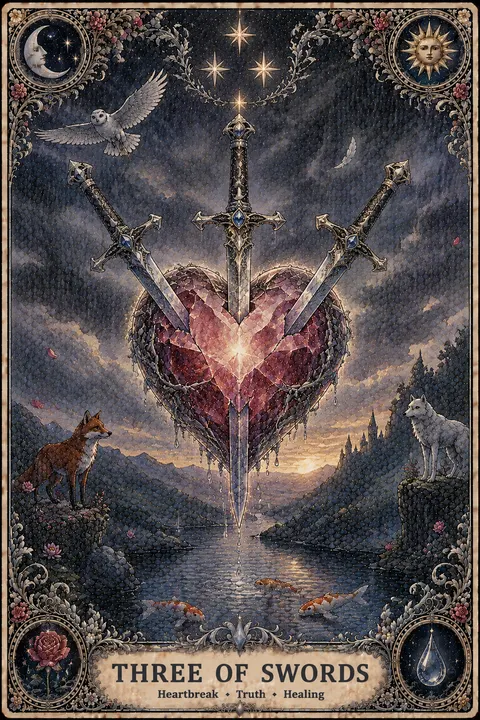
Three makes an experience visible. In Swords, an idea or truth can have an emotional consequence that needs acknowledgment.
Name the hurt and what actually happened. Clear language can help you seek support or communicate a need without minimizing the pain.
How can I talk about this hurt without turning the conversation into blame?
A painful experience may be easing or remaining unspoken. Let repair proceed honestly instead of requiring yourself to be over it on demand.
A reversal shifts the question you ask of the card. Read more about upright and reversed meanings.
Upright: Speak about a specific hurt rather than reducing the whole relationship to blame.
Reversed: Notice whether silence is protecting recovery or preventing needed communication.
Explore the wider relationship patternUpright: Separate disappointing feedback or conflict from your overall worth.
Reversed: Seek a clear conversation about what can be repaired or learned.
Reflect on how your situation is developingUpright: Review the practical effect of a disappointing decision with a clear head.
Reversed: Avoid using a new commitment to erase the feeling of an old disappointment.
Separate your responsibility from what you cannot controlUpright: Bring sorrow before God without explaining it away.
Reversed: Allow compassion to accompany truth rather than using truth as self-punishment.
Put your reflection into wordsThese reference symbols come from the Waite–Smith tradition. Our artwork is a reimagining, so it may differ from the traditional scene described below. The practical readings are our interpretation of the imagery.
| Symbol | Meaning and reflection |
|---|---|
| Pierced heart | The image gives emotional pain an unmistakable form. |
| Three swords | Thought, words, or truth can carry a painful consequence. |
| Rain and clouds | The surrounding weather reflects distress without defining all future seasons. |
Historical imagery reference: A. E. Waite’s The Pictorial Key to the Tarot. This guide’s modern applications are offered for reflection.
Explore the wider symbolism in the themes of the tarot suits.
A position gives the card a role. Read the meaning below alongside the orientation and the surrounding cards, instead of treating the same keyword as the answer everywhere.
| Position | What to consider |
|---|---|
| Past | A painful truth still influences the situation. |
| Present | Hurt needs acknowledgment. |
| Challenge | Blame or silence is interrupting repair. |
| Advice | Name the pain and seek fitting support. |
| Future or outcome | Understanding may make a different response possible. |
Pause if the choice repeats an unresolved hurt or avoids an important truth.
Sorrow does not follow a three-day schedule; attend to readiness and support.
Explore a focused yes-or-no questionIllustrative example · Not a generated reading
Suppose you ask, “How can I talk about this hurt without turning the conversation into blame?” and draw Three of Swords upright. One way to apply its theme is to work through these steps:
Acknowledge the wound and choose a form of support that fits it. Record the action and what you learned in a tarot journal.
Three of Swords represents painful truth, heartbreak, and making room for sorrow without turning it into your whole identity. Name the hurt and what actually happened. Clear language can help you seek support or communicate a need without minimizing the pain.
A painful experience may be easing or remaining unspoken. Let repair proceed honestly instead of requiring yourself to be over it on demand.
Speak about a specific hurt rather than reducing the whole relationship to blame. Reversed: Notice whether silence is protecting recovery or preventing needed communication.
Pause if the choice repeats an unresolved hurt or avoids an important truth. Treat this as a way to examine your choice, rather than a guaranteed result.
Three makes an experience visible. In Swords, an idea or truth can have an emotional consequence that needs acknowledgment.
Sorrow does not follow a three-day schedule; attend to readiness and support.
Acknowledge the wound and choose a form of support that fits it. A practical starting point: Describe the specific event.
No. It can describe hurt, disappointment, or a difficult realization. Another person's actions must be understood from actual context and evidence.
Choose your cards and orientations in the Tarot Cards Interpreter for help connecting a supported spread to your question. Your physical cards stay your draw; the tool adds an AI interpretation.
If you want to start a new reading, draw a random card online. A new draw can select any card.
For the reading process, return to how to read tarot cards.
God, hold what hurts and help me speak truth without abandoning compassion.